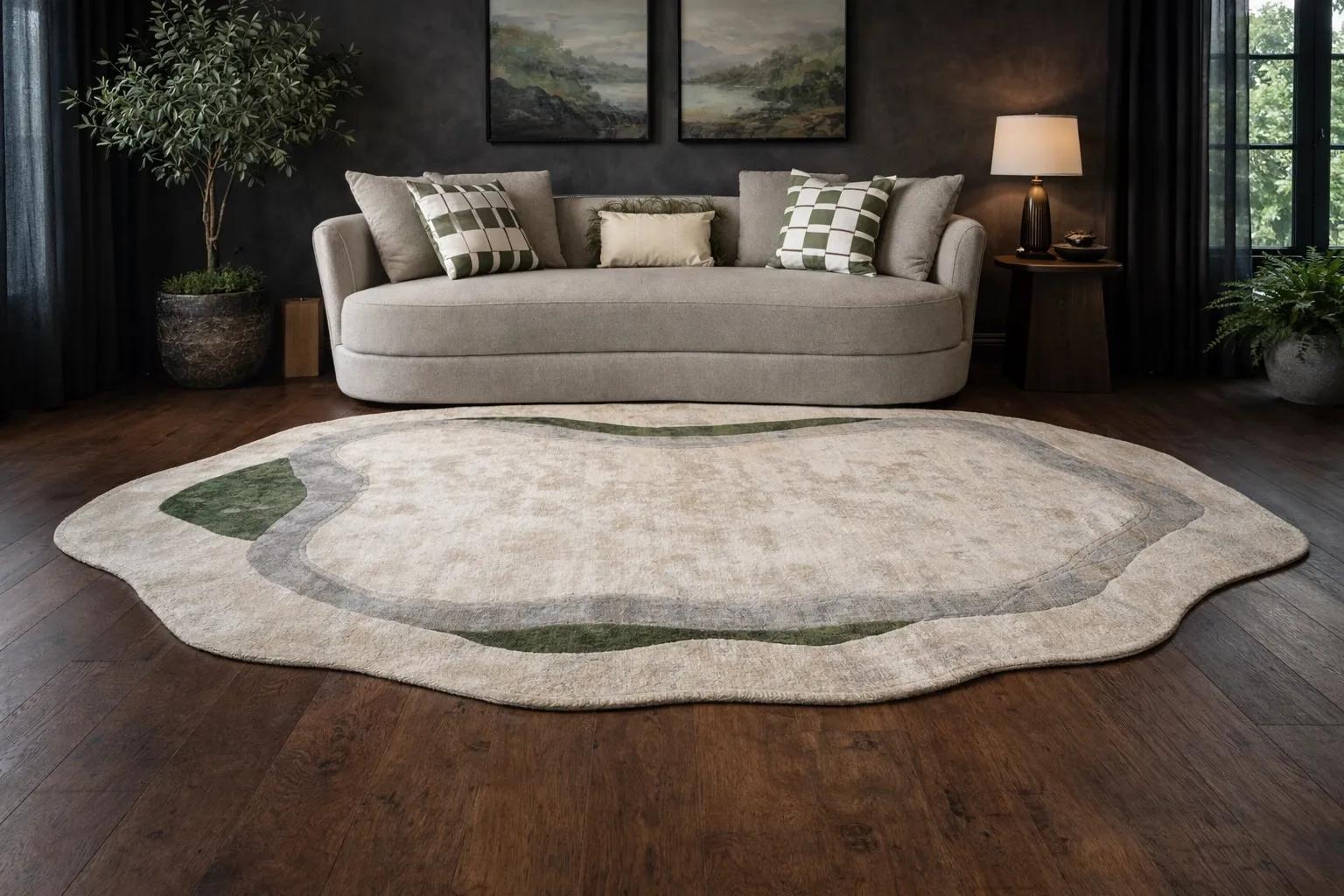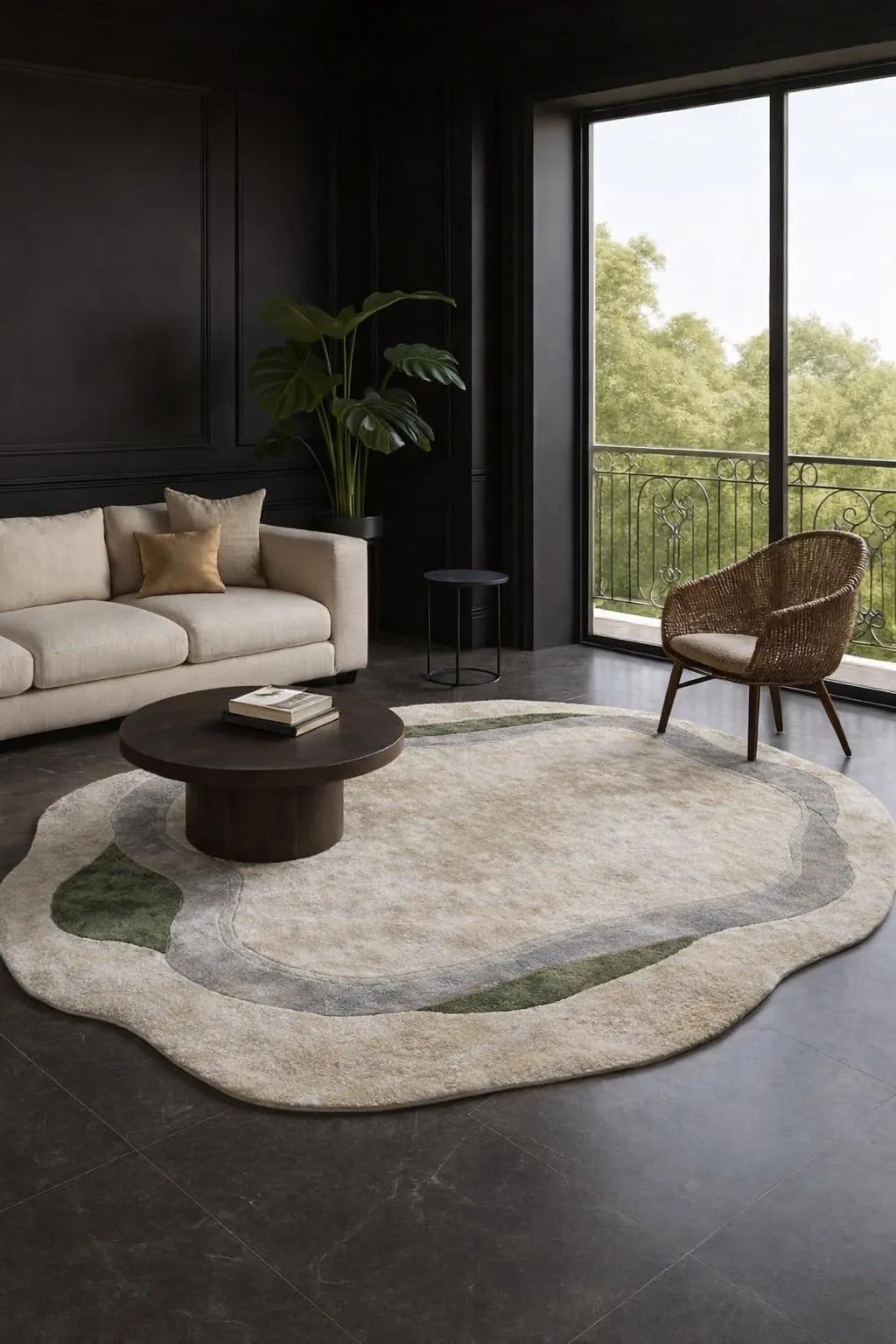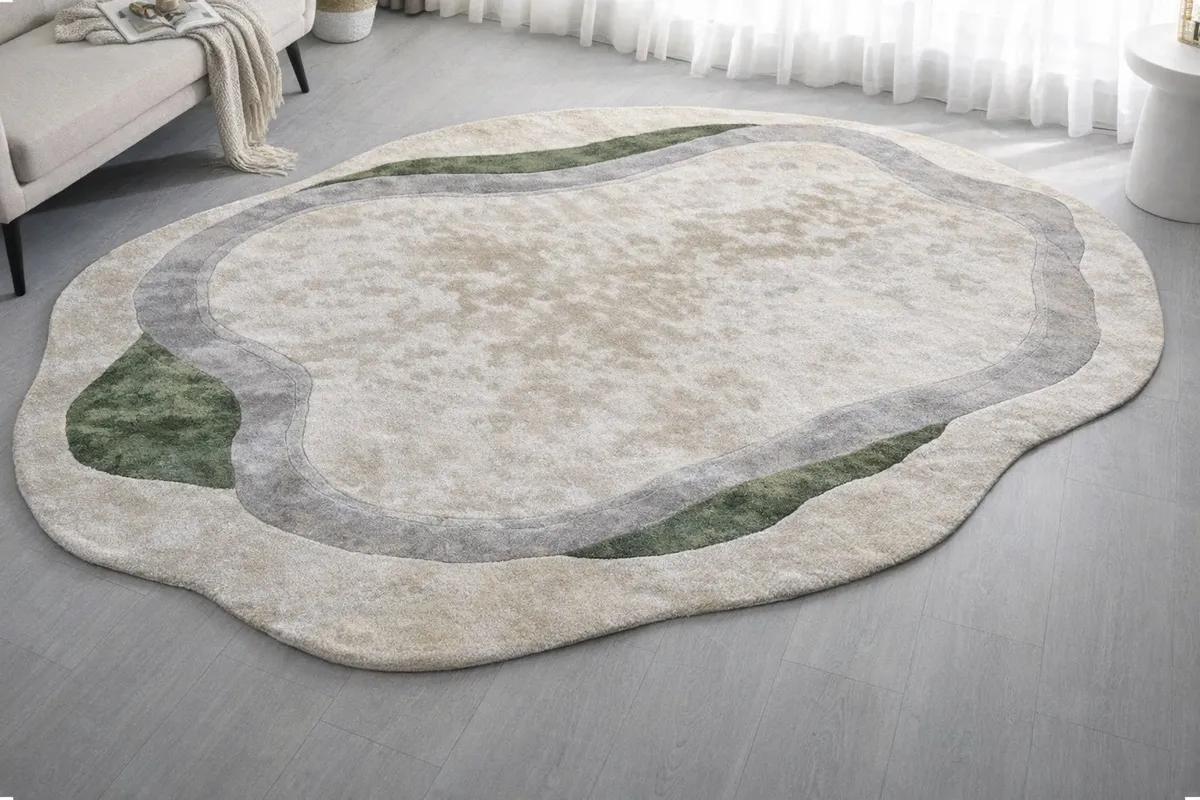
Shop for a rug in India and you will quickly meet two phrases: hand-tufted and machine-made. Sellers tend to present hand-tufted as self-evidently superior and machine-made as something to apologise for, but the honest comparison of hand-tufted vs machine-made rugs is more interesting than that. Each is the right answer for a different room, a different budget and a different stage of life. This guide explains how both are actually made — much of it within a few hundred kilometres of wherever you are reading this — and how to choose between them without regret.
How a hand-tufted rug is made
A hand-tufted rug starts with a design printed onto a stretched canvas backing. An artisan then works across it with a tufting gun — a hand-held tool that punches loops of yarn, usually wool, through the canvas, following the pattern line by line. Once the pile is complete, the back is coated with latex to lock the tufts, a secondary cloth backing is glued on, and the surface is sheared and carved by hand to bring out the design.
It is worth being precise about terms here. Hand-tufted is not hand-knotted. A hand-knotted rug is built knot by individual knot on a loom over months and priced accordingly — Bhadohi in Uttar Pradesh, the heart of India's carpet belt, is famous for them. Hand-tufting is a faster craft that delivers much of the hand-made character, the dense wool pile and the carved texture, at a fraction of the price. A single 5x8 foot hand-tufted rug still represents several days of one person's work.
How a machine-made rug is made
A machine-made rug is woven on a power loom — typically a Wilton or Axminster type — that produces the pile and backing in one continuous process. Modern looms work from digital files and can render surprisingly intricate patterns with perfect repeatability. Fibres are usually polypropylene, polyester or nylon, though wool machine-made rugs exist at the upper end. Panipat in Haryana, India's biggest rug-making hub, produces both machine-made and hand-tufted rugs, often in the same neighbourhoods.
The honest case for machine-made is strong: lower cost, consistent quality from piece to piece, stain-resistant synthetic fibres, and a lighter rug that is easier to move and clean.
The comparison, point by point
Factor · Hand-tufted · Machine-made Typical fibre · Wool, wool-viscose blends · Polypropylene, polyester, nylon Feel underfoot · Dense, soft, substantial · Thinner, springier, can feel flat Texture and depth · Carved, dimensional, slight irregularity · Uniform, printed-flat appearance Lifespan with care · 10–15 years · 3–8 years Shedding · Sheds wool for the first months · Minimal shedding Stain behaviour · Wool resists stains naturally but dislikes harsh cleaning · Synthetics shrug off most spills Weight · Heavy; stays in place · Light; may need anti-slip underlay Typical Indian price, 5x8 ft · ₹12,000–₹40,000 · ₹3,000–₹12,000
Two caveats keep this honest. First, hand-tufted rugs shed — expect to vacuum up loose wool fibre for the first two or three months, which is normal and tapers off. Second, the latex backing on a cheaply made tufted rug can degrade in a decade, occasionally leaving powder on the floor; a well-made one with quality latex and a stitched secondary backing avoids this for far longer.
What Indian homes should weigh
A few local realities sharpen the choice.
Monsoon humidity. Wool handles moisture well but dries slowly. Whichever rug you choose, lift it off the floor for an airing once or twice during the rains, and never lay a rug on a floor that is still damp from mopping.
Dust. Indian cities are dusty, and a dense wool pile holds dust deep. Hand-tufted rugs reward a proper vacuum twice a week; machine-made piles release dust more easily.
Dark furniture. Against sheesham and teak, the carved depth of a hand-tufted wool rug in ivory, sand or sage does something a flat machine print cannot — it gives the floor the same material seriousness as the furniture.
Stage of life. Toddlers, puppies and frequent house moves all argue for machine-made now and hand-tufted later. There is no virtue in ruining a wool rug.
Which one should you buy
Choose hand-tufted if the rug is going into a settled living room or bedroom, you want wool underfoot, and you can think in a ten-year horizon. Choose machine-made if the rug will live in a high-spill zone, under a dining table, in a rental, or in a child's room — or simply if the budget this year is ₹5,000 rather than ₹20,000. Both are legitimate decisions; only pretending one is the other is a mistake.
The short version
Hand-tufted rugs are hand-crafted wool pieces with depth, weight and a decade-plus lifespan; machine-made rugs are consistent, practical and far cheaper. Match the rug to the room's reality, not to the seller's hierarchy. Check the backing and pile density on a tufted rug, check fibre type and edge binding on a machine-made one, and whichever you choose, give it a good underlay and a regular vacuum — that is what actually determines how long a rug stays beautiful.
For what it is worth, SOISU sits deliberately on the machine-made side of this comparison. Our carpet range is precision machine-loomed, with a couple of hand-finished exceptions, because that is where the value genuinely lies for most Indian homes — consistent weave, intricate patterns rendered faithfully, easier care, and a price that does not demand a ten-year commitment. Every carpet is checked and photographed at our Prabhadevi studio before dispatch, so what arrives matches what you chose.