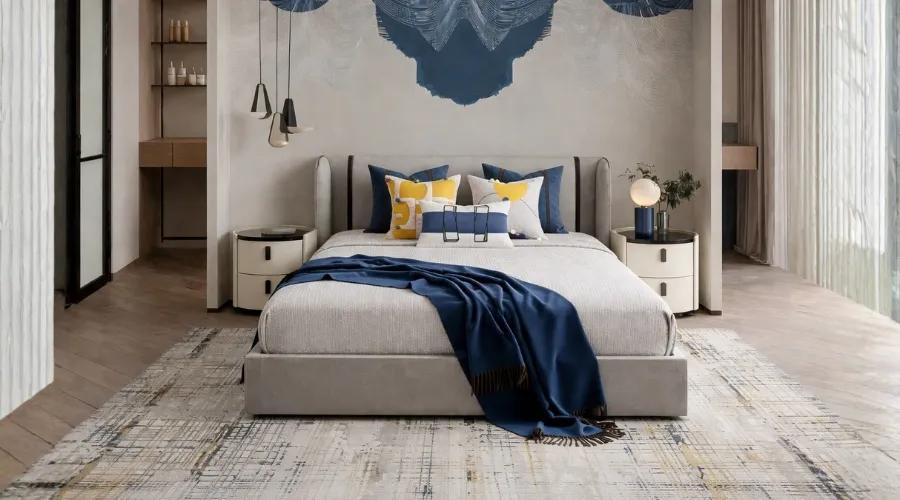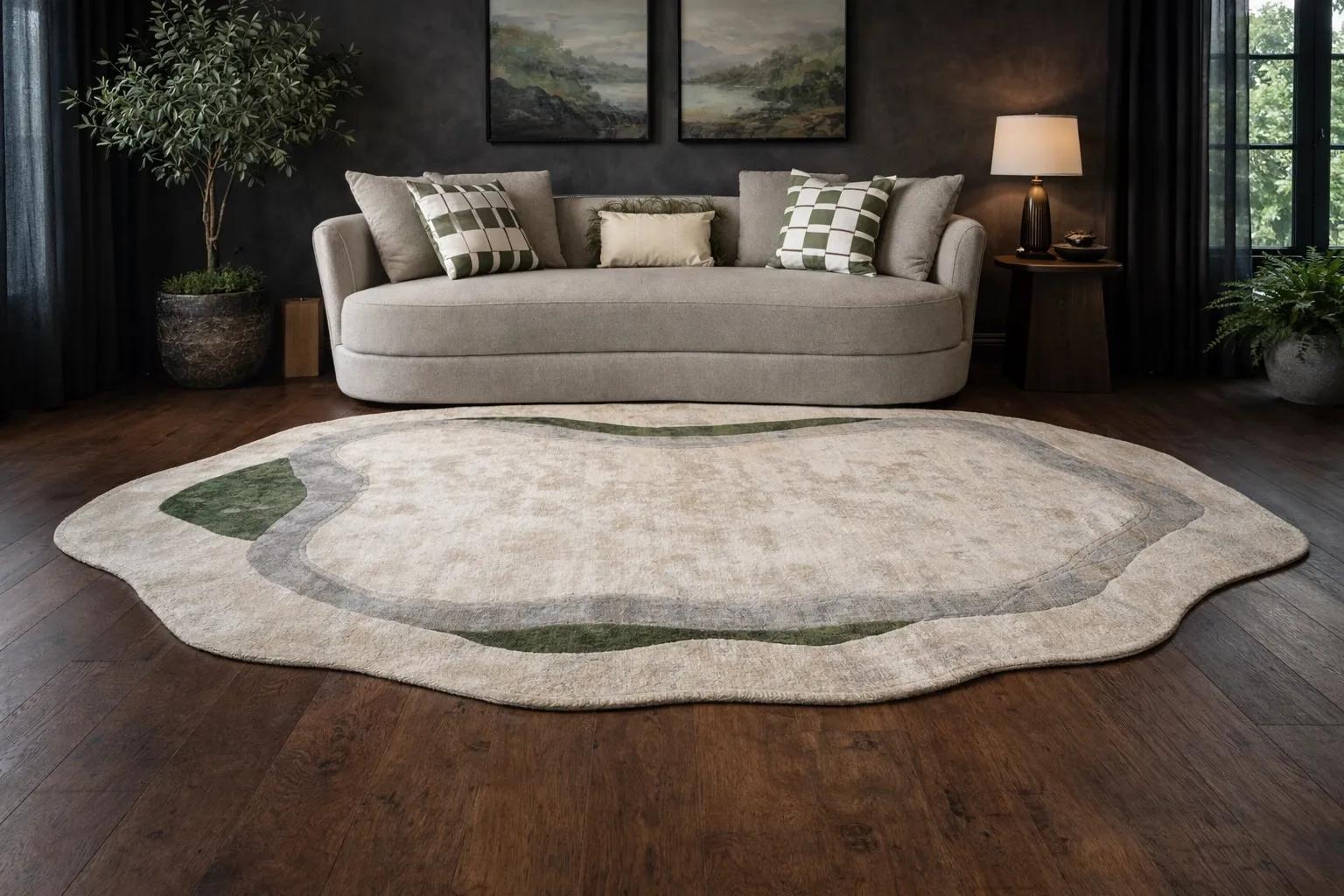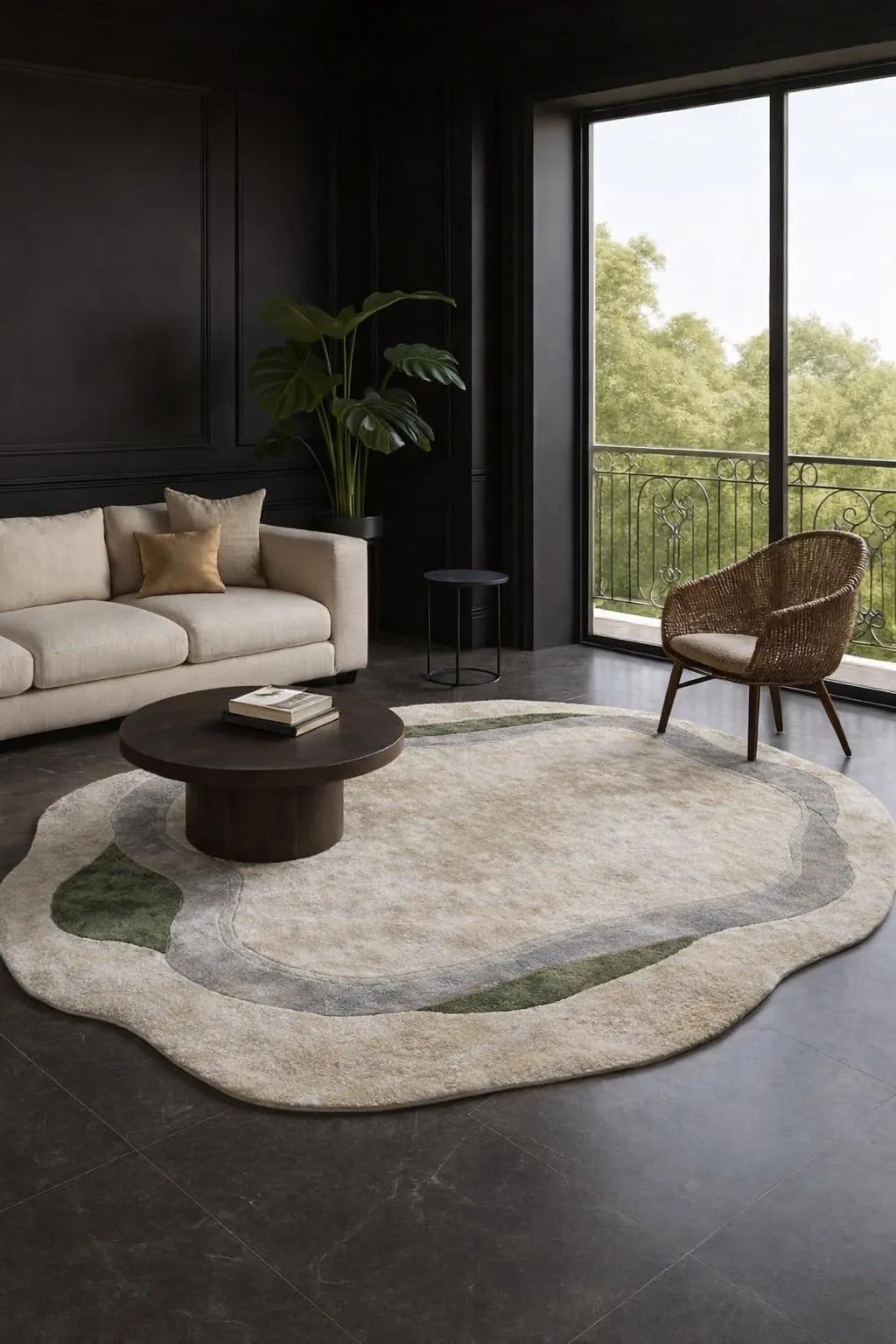
A rug size guide for Indian living rooms has to begin with an uncomfortable truth: most rugs in Indian homes are one size too small. The 4×6 ft piece floating in the middle of the floor, touching neither sofa nor chairs, is the national default — and it makes every room that contains it look smaller, choppier and vaguely unfinished. The rug is not a mat for the coffee table. It is the ground plane of the seating zone, and it needs to be sized like one. Here is how to get it right, in feet and inches, for the rooms most of us actually live in.
The one rule that decides everything
The front legs of every seat should sit on the rug. Sofa, armchairs, accent stool — front legs on, back legs off is the standard. (All four legs on is grander still, but demands rug sizes most Indian living rooms cannot take.)
This single rule explains why small rugs fail. If the rug does not reach the sofa, the furniture and the rug read as two unrelated objects, and the floor between them cuts the room into fragments. Once the front legs land on the rug, the seating zone snaps together into one composed block — and the room, paradoxically, looks bigger.
The three sizes, and where each belongs
Rug size · Suits · Typical setup 5 × 8 ft · Compact 1BHK living rooms, ~10 × 12 ft · 2-seater or small 3-seater plus one chair, front legs on 6 × 9 ft · The standard 2BHK living room, ~11 × 14 ft · 3-seater plus two chairs, front legs on; the default Indian buy 8 × 10 ft · Large 3BHK living rooms and open plans · Full seating group with all or most legs on
If you remember one size, remember 6×9 ft. It is the correct answer for the majority of Indian apartment living rooms, and it is the size people most often undershoot by buying a 5×8 — or worse, a 4×6 — instead.
Two checks before you order. First, leave a border of bare floor: 8 to 18 inches between the rug's edge and the walls or the main walkway, so the rug looks placed rather than wedged. Second, the rug should extend a few inches beyond the sofa's arms on both sides; a rug narrower than the sofa always looks like a doormat that wandered in.
The dining zone: chairs on, even when pulled out
Open-plan living-dining is the standard Indian apartment layout, and the dining rug has its own non-negotiable rule: chairs must remain fully on the rug even when pulled out to sit down. That means the rug needs roughly 24 to 30 inches of clearance beyond the table edge on every side.
Run the numbers and a 6-seater dining table needs a 9×6 ft rug — there is no smaller honest answer. A 4-seater can manage on 8×5 ft. If the room cannot take a rug that size in the dining zone, the better decision is no dining rug at all; a chair forever catching the rug's edge is a daily irritation no amount of pattern redeems.
Measure with newspaper, not hope
Before buying, mock up the rug on your floor:
Lay out newspaper sheets or masking tape to the exact rug dimensions in the actual position.
Sit on the sofa. Pull out a dining chair. Walk your normal routes for a day.
Check that the front legs of every seat land on the paper, and that walkways stay clear.
Ten minutes of newspaper has saved more money than any discount ever offered. It is also the moment most people discover their room wants the 6×9 and not the 5×8 they had budgeted for — better to learn it from the newsprint.
Material and pile, briefly
Size decided, material follows the household. Flatweaves and low-pile wool handle Indian dust, ceiling fans and wet-mop floors gracefully; high-pile belongs in bedrooms. SOISU's carpets are precision machine-loomed, which is exactly why a correctly sized 6×9 is more attainable than most buyers assume — the loom delivers consistency at a price a hand-knotted piece never could. Whatever the source, ask to see the actual piece photographed before dispatch; with rugs, the difference between catalogue and reality lives in the weave, and we photograph every order at our Prabhadevi studio for that reason.
Buy the rug for the seating zone, not for the coffee table. The coffee table was never the point.
The takeaway
The whole guide compresses to five lines. Front legs of every seat on the rug — this rule decides the size. Default to 6×9 ft for a standard 2BHK living room; 5×8 only for genuinely compact rooms; 8×10 for large or open-plan spaces. A 6-seater dining table needs 9×6 ft so chairs stay on when pulled out. Leave 8–18 inches of bare floor at the borders. And before any money moves, lay the size out in newspaper and live with it for a day. Rooms rarely lie; rugs bought without measuring usually do.